|
Highways 70 through 79
M-71 | M-72 | M-73 | I-75 | M-75 | M-77 | M-78 | M-79 | Jump to Bottom
|
|
 |
Western Terminus: |
Downtown Owosso at M-21 (cnr S Water St & E Main St) |
| Northern Terminus: |
I-69 at Exit 118 at Durand |
| Length: |
10.58 miles |
|
Map: |
Route Map of M-71 |
|
Notes: |
M-71 primarily serves as a connector route between I-69 at Durand and M-21 at Owosso, passing through Corunna, the Shiawassee Co seat, in the process. |
|
History: |
c.1920 - M-71 begins as a 4.5-mile spur route from M-21 between Corunna and Lennon and runs southerly into downtown Durand. At this time M-21 follows present-day Lytle Rd between Corunna and Lennon. |
|
|
c.1925 - M-21 is realigned between Owosso and Lennon on its present-day routing and the route of M-71 is altered as well. Still beginning in downtown Durand, M-71 heads northerly for 2 miles via Durand Rd, then westerlyy 2 miles via Bennington Rd into Vernon. From Vernon, M-71 stairsteps westerly via Parmenter Rd, then angles due northwesterly into Corunna, where it picks up the former routing of M-21 into downtown Owosso, where it ends. |
|
|
c.1933-34 - The completion of the first segment of the new M-78 between Swartz Creek and Perry results in the realignment of M-71 between Vernon and the new M-78 , present-day Lansing Rd. (The former route is turned back to local control.) At this time, M-71 is also truncated at M-78, with the former route of M-71 into downtown Durand becoming part of a temporary routing of M-78. |
|
|
1935 - The final link of M-78 near Durand from Newburg Rd to M-71 is completed and the former route of M-71, then M-78, into downtown Durand is redesignated as part of M-71. (One 1934 Official Michigan highway map shows this "spur" route as M-176, but that seems to has been in error.) |
|
|
1938 - M-71 is rerouted onto new alignment from M-78 at Durand to Parmenter Rd near Corunna, paralleling the Ann Arbor Railroad between those towns. The former route is turned back to local control. Also, with the realignment, all of M-71 is now completely hard-surfaced. |
|
|
1939 - The short spur routing of M-71 from M-78 into downtown Durand is turned back to local control in early 1939, and the eastern terminus of M-71 is moved back to the western jct of M-78/Lansing Rd. |
|
|
1960 - A portion of the new M-78 freeway (present-day I-69) is completed at Durand and M-71 is scaled back to terminate at the new freeway, shortening the route of M-71 by only several hundred yards. |
|
Freeway/Expwy: |
No portion of M-71 is freeway or expressway. |
|
Photographs: |
|
|
Weblinks: |
M-71 @ Michigan Highway Ends - photos of the termini of M-71 at Dan Garnell's excellent Michigan Highway Ends website. |
|
 |
Western Terminus: |
Empire at M-22 |
| Eastern Terminus: |
US-23 in Harrisville (cnr Main St & State St) |
| Length: |
133.88 miles |
|
Map: |
Route Map of M-72 |
|
Notes: |
One of only three cross-peninsular "M-numbered" state highways in the Lower Peninsula. The others are M-46 (Muskegon-to-Port Sanilac) and M-55 (Manistee-to-Tawas City). |
|
|
M-72 started as a short highway in Alcona Co, beginning near Lincoln and heading easterly into Harrisville, before turning southerly to follow the Lake Huron shoreline to Greenbush. Over the years, M-72 was extended westerly in spurts, first in 1923, then again in 1927, 1932, and 1940, when it replaced the M-76 designation west of Grayling. Further extensions in 1946 and 1947 completed the highway from coast-to-coast. |
|
|
M-72 between Grayling and Traverse City is a heavily-travelled corridor, carrying travellers between downstate areas and the Grand Traverse region. Because of this, the highway is slowing being upgraded, with several miles of new passing lanes completed in the past several years. More development along the corridor plus additional growth around Traverse City will require many more upgrades to come. One upgrade, a direct connection between M-72 & I-75 in Grayling, is already being studied. |
|
History: |
c.1920 - The earliest routing of M-72 begins at M-10 (later US-23 and M-171, now F-41) south of Lincoln and proceeds easterly to Harrisville, then southerly along the Lake Huron shore to end in Greenbush. |
|
|
1923 - M-72 is exteneded westerly from M-10 for 7 miles via its present-day alignment to end at Bean Hill Rd southeast of Barton City. |
|
|
c.1927 - M-72 is extended in two directions:
- From its eastern terminus in Greenbush south of Harrisville, M-72 is extended southerly to end at US-23 in Oscoda.
- From its western terminus near Barton City, M-72 is substantially extended westerly through Curran, Hardy, and Fairview to Mio. From Mio through Luzerne to M-76 east of Roscommon, M-72 traverses the former alignment of M-33, which is transferred easterly to run via Rose City.
|
|
|
c.1932 - M-72 is realigned onto a more direct alignment in southeastern Crawford Co, southwest of Eldorado. The former route is turned back to local control. |
|
|
1936 - When the new shoreline routing of US-23 is completed between Oscoda and the Alpena/Alcona Co line via Harrisville, the route of M-72 is scaled back to end in downtown Harrisville. The former route between Harrisville and Oscoda becomes part of US-23. |
|
|
1940 - The routing of M-72 is drastically altered west of Luzerne this year. Beginning at Luzerne, M-72 now runs due westerly via a new route on "earth-surfaced" roadway for nine miles into Crawford Co to meet the eastern end of M-208 at the South Branch of the Au Sable River. From the South Branch into Grayling, a total of 13 miles, M-72 supplants the M-208 designation. The former routing of M-72 southwesterly from Luzerne to M-76 east of Roscommon is redesignated as M-144. From US-27 in Grayling heading westerly for 24 miles to M-66 south of Kalkaska, the M-72 designation replaces M-76 along the route. More then 45 miles west of Kalkaska, a short 7 mile long discontinuous segment of M-76 is also redesignated as M-72, thus rendering M-72 as a disconnected highway with two segments. |
|
|
1946 - The western segment of M-72 is lengthened by 16 miles, running easterly viaexisting county roads into Traverse City, roughly along its present-day routing. |
|
|
1947 - M-72 becomes one complete highway when the gap between the disconnected segments is filled. From the east end of the western segment at Traverse City, the M-72 designation runs easterly through Traverse City via US-31 to Acme, then easterly through Bates, Williamsburg and Barker Creek on existing county roads to Kalkaska. There, M-72 turns southerly with US-131/M-66 into downtown, then southerly via M-66 to the western end of the eastern segment. Also, some sharp curves just east of Empire are bypassed with a short stretch of new highway. |
|
|
1948 - In late 1948, a short realignment on new highway bypasses several sharp curves along M-72 at the Cedar Run in extreme south-central Leelanau Co. |
|
|
1951 - In late 1951, both M-72 and M-33 are realigned onto their present routing between Mio and Fairview. The former routing for both highways along Kneeland & Knepp Rds is turned back to local control. |
|
|
1953 - The southernmost four miles of the concurrent M-65/M-72 segment in Alcona Co into Curran is "straightened" and paved. The short segments of the former route are turned back to local control. |
|
|
1957 - After 17 years, the first 7 miles of the "earth-surfaced" segment of M-72 in eastern Crawford Co is finally paved. The last three miles of that segment are paved by 1960, twenty years after it opened! |
|
|
1959 - Four changes to the route of M-72 occur in 1959:
- The last 9 miles of the Traverse City-to-Kalkaska segment are paved, leaving only the Luzerne-to-Mio segment of M-72 unpaved.
- The last short segment of "earth-surfaced" highway in Crawford Co is paved.
- The Fairview-to-Hardy segment is improved when M-72 is moved from Weaver & Oakes Rds onto Miller Rd and new alignment east of Fairview, and a pair of sharper curves at the hamlet of Hardy on the Oscoda/Alcona Co line are bypassed with a mile of new highway. The entire stretch of highway from M-33 at Fairview to M-65 north of Curran is also paved in the process.
- M-72 is also realigned southeast of Curran in Alcona Co to run due westerly to meet M-65 two miles south of the former southern jct of M-65 & M-72, lengthening the concurrent segment by two miles and lengthening the route of M-72 by one mile. That segment of M-72 is also paved in the process.
|
|
|
1960 - The last several miles of gravel-surfaced M-72 are paved between Luzerne and Mio. |
|
|
1961 - M-72 is realigned onto mostly new highway between Barker Creek and the western edge of Kalkaska. The former route is turned over to local control, much of it being named Old M-72. Also, with the completion of I-75 around Grayling, the concurrent US-27/M-72 segment through town becomes BL I-75/M-72. |
|
|
1974 - M-66/M-72 is realigned on the south side of Kalkaska onto a new highway constructed as a continuance of M-72 to US-131 southwest of downtown. M-66/M-72 then continues northeastrtly via US-131 into downtown to the highways' former alignment. The former routing of M-66/M-72 via present-day Old M-66 and Court & Elm Sts is eventually turned back to local control (although it is not clear when this jurisdictional transfer took place). |
|
|
1978 - Michigan's only "runaway truck ramp" (or, as MDOT calls it, a "truck trap") is constructed on M-72 west of Traverse City, west of the junction with M-22. The cost of this "truck trap" was $66,400, as lies near the bottom of a long down-grade. Beyond the ramp is a busy intersection with M-22 and the West Arm of the Grand Traverse Bay. |
|
Freeway/Expwy: |
No portion of M-72 is freeway or expressway. |
|
NHS: |
From jct US-31, M-22, M-37& M-72 in Traverse City to southern jct of BL I-75 in Grayling. |
|
Circle Tour: |
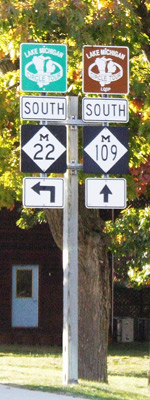
Lake Michigan Circle Tour: From the western jct of US-31 in Traverse City to the eastern jct of US-31 in Acme. |
|
Photographs: |
|
|
Weblinks: |
M-72
@ Michigan Highway Ends - photos of the termini of M-72 at
Dan Garnell's excellent Michigan
Highway Ends website. |
|
|
I-75BL/Au
Sable River Bridge - from MDOT: "The
Grayling Bridge carries M-72 over the Au Sable River in the middle of the
city’s central business district." |
|
 |
Southern Terminus: |
Wisconsin state
line (connection w/WI STH-55) 9 miles southwest of Iron River |
| Northern Terminus: |
US-2 one mile
west of Iron River |
| Length: |
08.2 miles |
|
Map: |
Route Map of M-73 |
|
Notes: |
M-73 is a short highway
serving as a connection between Iron River and STH-55 (State Trunk Highway
55) in Wisconsin. No major changes have occurred to the route of M-73 since
the mid-1930s. |
|
History: |
c.1936-37 - All 8.2
miles of M-73 are paved in 1936 or 1937. The route was formerly entirely
gravel-surfaced. |
|
Freeway/Expwy: |
No portion of M-73 is freeway or expressway. |
|
Continue on: |
STH-55 into
Wisconsin |
|
Photographs: |
|
|
Weblinks: |
M-73
@ Michigan Highway Ends - photos of the termini of M-73 at
Dan Garnell's excellent Michigan
Highway Ends website. |
|
 |
Southern Entrance: |
Ohio state line south of Erie and north of Toledo, Ohio |
| Northern Terminus: |
Ontario provincial
boundary on the International
Bridge between Sault Ste Marie, Michigan and Sault
Ste Marie, Ontario |
| Length: |
395.40 miles |
|
Map: |
Route Map of I-75 |
|
Notes: |
I-75 is Michigan's
longest route-numbered highway, stretching from Ohio on the south through
the entire Lower Peninsula, across the mighty Mackinac
Bridge and across
the eastern end of the Upper Peninsula, terminating at the Ontario border in
Sault Ste Marie. As such, I-75 is often referred to as "Michigan's
Main Street." Not
only is I-75 a major north-south route in the U.S., it is equally important
to commerce and travel within the state of Michigan. On the tourism side,
I-75 is the preferred route for Detroiters heading "Up North" on
weekends and holidays. Major back-ups regularly occur on southbound I-75
at the end of major summer holiday weekends. |
|
|
In the Metro Detroit area, I-75 is known as the Fisher
Freeway from the Downriver area into downtown, then as the Walter P Chrysler
Frwy from downtown northerly to the Pontiac area. I-75 is also Michigan's
busiest highway, with and average of more than 200,000 vehicles passing over
the highway each day between the M-8/Davison Frwy and I-696/Walter P Chrysler
Frwy. |
|
|
The only route designation to currently cross the Mackinac
Bridge and
the Straits of Mackinac is I-75. Only two other routes crossed the straits:
US-31 did in the 1930s via the
state ferries, and US-27 did in the late 1950s when the Bridge first opened. |
|
|
While several temporary routings of I-75 have existed during the 1960s
and '70s in gaps between completed segments, one was longer than the others
in both length and existence. Between 1961 and 1973, a rather large gap
in I-75 existed between Bay City and US-27 south
of Grayling. As this gap was slowly being filled (with the freeway being
designated as M-76 in the interim), a temporary routing of I-75 ran northwesterly
via US-10 from Bay City to Clare, then northerly via US-27 to
the Grayling area. Highway maps of the era, both official and otherwise,
showed this routing as "TO I-75" and it has been reported the
route was signed similarly in the field (and not using the "TEMPORARY"
designation used later on I-69).
This route could not be posted as part of I-75 (e.g. without the "TO" signage)
as US-27 between Clare and Higgins Lake was only a controlled-access
expressway, with intersections at several roads, from 1961 until c.1966.
After 1966, US-27 in that area had been upgraded to a full freeway. |
|
|
In the early 1960s, while the Interstate highway building boom was going full tilt, the program was also suffering a bit of a negative identity crisis. Some were alleging the program was a bottomless pit of waste for taxpayer dollars as some instances of fraud and misappropriation of funds had occurred alongside the building of hundreds of miles of new freeway across the nation. As President John F Kenney took office in 1961, he and those in his administration tried to stem the tide of negative public opinion by initiating several programs to tout the benefits of the new Interstate highway system. One such program was the the weekly supplement to Sunday newspapes, Parade Magazine, cooperating with the Bureau of Public Roads in holding a competition to select America's finest new scenic highways. In an October 1963 issue of Parade, the 22.5-mile segment of I-75 from Vanderbilt to Indian River (part of the so-called "Ohio-to-Soo Freeway" as it was often referred to then) was selected as that year's finest example of a "driver's road" for scenery, speed and safety from across the country. The award was officially called the "Parade Magazine Scenic Highway Award" for 1964, as the selection in late October, 1963 was to be awarded the following year. Unfortunately, the announcement of the selection of this segment of I-75 ended up being pushed aside in many newspapers by the assassination of President Kennedy soon after. |
|
History: |
1958 - The first
I-75 route markers began popping up in Michigan along the Detroit-Toledo
Expressway, which has been designated ALT US-24 until now. This first
segment of I-75 signed in Michigan begins at a connection with I-75 and I-280
in Toledo, Ohio and proceeds northerly to West Rd near Trenton in extreme
southern Wayne Co. Much of this freeway was opened to traffic in 1956, ironically
as the Interstate Highway Act of 1956 was being signed into law by President
Eisenhower. Other segments of freeway open to traffic, or being opened to
traffic, in 1958 which would become parts of I-75 over the next two years
are:
- US-23: Fenton-Clio Expwy - from the southwest
side of Flint to Birch Run, opened in 1957-58.
- Mackinac
Bridge and Approaches - Beginning
at US-23/US-27 in
Mackinaw City (present-day Exit 338), then northerly across the Bridge,
ending at US-2 in St Ignace,
designated as US-27. Some sources
show the southern approach freeway may have been completed southerly
from US-23/US-27 to
Nicolet Ave-Mackinaw Hwy (then US-31,
now M-108), but that segment
may not have been opened to traffic for another year.
- US-2 - a segment
of new freeway opened in 1957 from Evergreen Shores (present-day
Exit 348) to M-123 at Exit 352.
|
|
|
1959-60 - The above segments of freeway are all
designated as parts of I-75, and route markers are erected along all
parts of those routes by 1960. I-75 becomes a concurrent designation with
those freeway segment's former designations, with the exception of the Mackinac
Bridge, which becomes just I-75. US-23, US-27 and US-31 are
all routed northerly from their respective junctions with I-75 to terminate
at the southern end of the actual bridge structure, at the location of the
Huron St overpass in Mackinaw City. To this day, a remanant of that still
exists: at the Huron St overpass, a three-panel sign assembly consisting
of "NORTH," "I-75"
and up-arrow markers exist where the assembly that once also included US-23,
US-27 and US-31 route
markers and "ENDS" plates below each. Also during
this time, the I-75/US-31 freeway
is extended south of Mackinaw City to present-day Exit 336. |
|
|
1960 - Three new segments of freeway, noted
below, are opened in 1960 and I-75 now exists in four segments:
- A segment of the I-75/US-10/US-23 freeway
opens from the jct of US-23 & M-81,
crosses the Saginaw River via four-lane bascule Zilwaukee
Bridge and continues northerly past Bay City (where the US-10 freeway
departs for Midland), ending in Kawkawlin. The US-10 designation
is moved onto the Saginaw bypass and the newly completed freeway northerly
to Bay City. The former alignment of US-23 between Saginaw and Kawkawlin
becomes an extension of M-13.
The former BUS US-23 through Saginaw becomes, in part, BL I-75.
- From US-27 between Indian River
and Topinabee to the south end of the completed freeway south of Mackinaw
City (present-day Exit 336 at M-108).
- From US-2 to the completed
segment near Evergreen Shores, bypassing St Ignace. The former route
of US-2 through St Ignace is
redesignated as BL I-75.
|
|
|
1961 - Four more changes to I-75:
- The gap in the I-75/US-10/US-23 freeway
from Birch Run to Zilwaukee is filled when the new freeway opens to
traffic in 1961. From the north end of the "Fenton-Clio Expressway" at
Birch Run to the south end of the freeway opened to traffic in 1960
at M-81 northeast
of Saginaw. Between Bridgeport and M-81,
the two-lane bypass completed in 1952 is used for part of the new freeway.
The former US-23 south of Bridgeport
via Dixie Hwy is turned back to local control.
- Beginning at the northern
end of the new US-27 expressway
between Higgins Lake and Grayling, a new segment of I-75 freeway opens
to traffic past Grayling, Frederic and Otsego Lake, ending at M-32 on
the west side of Gaylord. The first five miles of the new freeway were
built using the existing US-27 highway.
The former US-27 northbound lanes become
the southbound lanes of I-75, while the northbound side of the freeway
was constructed on new alignment. The old southbound US-27 lanes
are still evident today as an extended grassy area on the west side of
I-75's southbound lanes. Through Grayling, the former US-27 south
of M-93/Hartwick Pines Rd becomes
part of a new BL
I-75, while the remainder
of Old US-27 to Gaylord is turned back to local control.
- In order to shuttle
through traffic between the completed segments of I-75 freeway south
of Bay City and north of Grayling, a special "TO I-75" designation
is created. TO I-75 begins at the I-75/US-10/US-23 &
M-15/M-25 jct
west of Bay City and proceeds westerly and northwesterly via US-10 past
Midland to Clare. TO I-75 then turns northerly via the brand-new US-27 expressway
to the southern end of the completed I-75 segment between Higgins Lake
and Grayling.
- A second "TO I-75" designation is commissioned to replace US-27 between
Gaylord and Indian River. This "TO I-75" routing begins at
the northern end of the completed freeway at Gaylord and heads easterly
via M-32/Main St into downtown,
then turns northerly via the former US-27 through
Vanderbilt, Wolverine and Indian River to the southern end of the next
completed I-75 segment north of Indian River. It is unclear whether the
Michigan State Highway Dept ever replaced all of the US-27 shields
with "TO
I-75" route marker assemblies
or not. Hopefully, further research will clear up this point.
|
|
|
1962 - Four new segments of I-75 freeway are opened to traffic:
- A new segment beginning at M-24 northeast
of Pontiac and proceeding northwesterly to US-23 on
the southwest side of Flint is completed. The
US-10 designation is transferred
from the parallel Dixie Hwy between the Clarkston area and Flint. The
former US-10 along
Dixie Hwy is turned back to local control, while the former route of US-10 north
of the Oakland/Genesee Co line past Flint and Clio is redesignated as M-54.
- The
Gaylord-to-Indian River freeway gap is filled when 31 miles of I-75
opens between M-32 and M-27 in
the fall of 1962.
- A short segment of I-75/US-2 freeway
is completed from Tone Rd near Kinross to Mackinaw Trail at Dafter
in central Chippewa Co. The former route of US-2 is
turned back to local control.
- With the completion of the new International
Bridge linking the twin Sault
Sainte Maries and crossing the St Marys River/Soo Locks, the three
miles of I-75/US-2 freeway
heading southerly away from the bridge is completed. The former route
of US-2 into
downtown Sault Ste Marie is redesignated as BS
I-75.
|
|
|
1963 - In addition to the five freeway completions and the "TO I-75" designation
below, a BL I-75 designation is added to run through downtown Pontiac, replacing
the BUS M-24 routing. The other major changes to I-75 are:
- A short freeway extension is completed north of US-25/Toledo
Hwy north of Woodhaven, connecting into northbound US-24/Telegraph
Rd. With the completion of this short extension, a new "TO I-75" designation
is commissioned in the Detroit area. From the northern end of the new freeway
extension in Taylor Twp, this new "TO I-75" runs northerly
via US-24/Telegraph Rd for 15 miles
to M-102/Eight Mile Rd, then easterly
for 9.2 miles via M-102/Eight
Mile to the former M-150/Stephenson
Hwy, 2/3-mile east of the intersection of John R Rd & Eight Mile
Rd. From there, TO I-75 turns northerly via the former M-150/Stephenson
Hwy routing for three miles to the southern end of the I-75 freeway
in Oakland Co.
- The first segment
of the Walter P Chrysler Frwy is completed between downtown Detroit
and I-94/Edsel Ford Expwy north
of downtown. The first 1.25 miles are designated as I-375,
while the remainder to I-94 is
designated as a segment of I-75.
- The
portion of I-75 through Oakland Co is extended southeasterly from M-24 northeast
of Pontiac, winding through Pontiac Twp (now Auburn Hills), Troy and
Royal Oak, ending just north of the intersection of 11 Mile Rd & Stephenson
Hwy. The portion of the parallel M-150/Stephenson
Hwy from Troy to Madison Heights is turned back to local control, while
the portion of the former M-150 between M-102/Eight
Mile Rd & 11 Mile Rd is redesignated as a part
of a new "TO
I-75" (see above).
- The remaining two uncompleted segments of the I-75/US-2 freeway
in the Upper Peninsula are completed and opened to traffic. In both
cases, the former routing of US-2 via
Mackinac Trail is turned back to local control, with the exception
of three miles at Rudyard, which become part of M-48.
Those two new segments are:
- From M-123 north of St
Ignace to Tone Rd at Kinross (present-day Exit 378).
- From
Mackinac Trail near Dafter (approximately Mile 384) to BS
I-75/Three
Mile Rd at Sault Ste Marie.
|
|
|
1963 (Oct) - As detailed in the "Notes" section above, the 22.5-mile segment of I-75 freeway completed and opened to traffic the previous year is given the "Parade Magazine Scenic Highway Award" for 1964, selected as the year's finest example of a "driver's road" for scenery, speed and safety from across the country. |
|
|
1966 - One new segment of I-75 is completed and
another is begun, both in the Metro Detroit area. With the completion and/or
commencement of these two freeway segments, the "TO I-75" designation
still exists in the Metro Detroit, however partially relocated. Now, TO I-75
begins at the jct of I-75/Fisher Frwy & M-39/Southfield
Hwy in Lincoln Park, and proceeds northerly via M-39 (Southfield
Hwy & Southfield Frwy) to M-102/Eight
Mile Rd, then easterly via M-102 to
the southern end of the "in-progress" freeway segment at Hazel
Park.
- In southern Wayne Co, I-75 is extended northeasterly for 8 miles from
the US-24/Telegraph Rd connector
(present-day Exit 35) to Schaefer Hwy in southwest Detroit. Construction
is underway to connect this new segment with the Walter P Chrysler Frwy
north of downtown.
- The divided highway segment of "TO I-75" running
along the former M-150/Stephenson
Hwy begins conversion to an urban depressed freeway, with a relocated
Stephenson Hwy running along each side of the new I-75 as frontage
roads. This new segment under construction runs between 8 Mile & 11
Mile Rds in Hazel Park and Royal Oak.
|
|
|
1967 - Two more segments of freeway open in 1967:
- A 30-mile segment of US-23 freeway
opens from the existing US-23 freeway
3 miles south of Kawkawlin northerly to end at existing US-23 three
miles south of Standish. While signed only as US-23,
this freeway segment is the first of several segments filling the Bay City-to-Grayling
gap in I-75. The former route of US-23 from
Kawkawlin to the north end of the freeway south of Standish is initially
designated ALT US-23, but becomes a further extension of M-13 within
a year. The three mile segment of former US-23 freeway
south of Kawkawlin bypassed by the new freeway is re-designated as CONN
M-13.
- A new portion of the I-75/Fisher Frwy are completed in southwest
Detroit. The segment begins about 1/2 mile beyond the northern end
of the completed freeway at Schaefer Hwy, and proceeds across the River
Rouge Bridge, then parallels US-25/Fort
St before ending at the Clark St interchange west of downtown. Apparently,
the M-85/Fort St overpass was
not completed in 1967, and traffic was directed east on Schaefer Hwy,
across M-85/Fort
St to Patricia Dr, then north along Patricia Dr to Pleasant St, then
jogged back onto the new freeway at that point.
|
|
|
1968 - Four more freeway segments are completed
and opened to traffic, each noted below. Even with the second, third and
fourth entries below denoting freeway completions in Detroit, the "TO
I-75" designation
remains along M-39/Southfield Frwy and M-102/Eight Mile Rd, since a gap
in the freeway from Clark St to 12th St remains to be filled.
- A 17-mile segment of freeway is completed from the
US-23 freeway southwest of Standish to M-33 at Alger and is designated
as M-76. The former route of M-76 from US-23 in
Standish to M-33 is turned back to local control as "Old M-76." While
posted and designated as M-76, this new freeway was the second segment
of freeway built to fill the Bay City-to-Grayling freeway gap.
- In southwest Detroit, the short
portion of the I-75/Fisher Frwy over M-85/Fort
St, as noted above, is complete.
- A portion of the I-75/Fisher Frwy built along Vernor Hwy across
the north side of downtown Detroit, is completed between 12th St
(present-day Rosa Parks Blvd) and US-25/Gratiot
Ave, including the interchanges at BS I-696/John C Lodge Frwy and
I-75/I-375/Walter
P Chrysler Frwy.
- The final segment of the Walter P Chrysler Frwy within the City
of Detroit is completed, when the segment of freeway from I-94/Edsel
Ford Frwy to M-102/Eight Mile
Rd is opened to traffic and designated a part of I-75. This section
includes the massive interchange with the Davison Expwy (now M-8/Davison
Frwy). In addition, the first 1-1/2 miles of the new I-75/W P Chrysler
Frwy opens north of M-102 along
the former alignment of M-150/Stephenson
Hwy. The gap in the freeway remains, however, from just south of Woodward
Heights to just north of Lincoln Ave in Hazel Park and Royal Oak, while
another massive interchange is built at 10 Mile Rd.
|
|
|
1969 - Even though no futher freeway completions on I-75 occur in Detroit,
including the continued existence of the Clark St-to-12th St gap west of
downtown, the "TO I-75" designation along M-39/Southfield Frwy
and M-102/Eight Mile Rd is removed. |
|
|
1970 - The final portion of I-75 within the City
of Detroit is completed, filling the Clark St-to-12th St gap, including and
interchange with, and the first 3.5 miles of, the Jeffries Frwy (to become
part of I-96). Also
in 1970, two segments of the M-76 freeway are completed:
- From the northern end of the completed freeway at M-33 near
Alger to present-day Exit 210 at Cook Rd south of West Branch. A new
highway built on new alignment from the Cook Rd exit back to Old M-76
is constructed to carry traffic to and from the new freeway.
- A short segment of M-18/M-76
freeway opens from the I-75-to-US-27 transition
(between Higgins Lake and Grayling) southeasterly to existing M-18/M-76
west of the Village of Roscommon. The former route of M-18/M-76
is turned back to local control.
|
|
|
1971 - In Metro Detroit, the final segment of I-75/Walter P
Chrysler Frwy in Hazel Park and Royal Oak is finally complete and open
to traffic and a fully-controlled access urban depressed freeway. Included
in this segment is a massive triple-deck interchange at 10 Mile Rd which
will accommodate the proposed easterly extension of I-696/Walter
P Reuther Frwy across the northern suburbs. Until I-696 is
completed, the massive "interchange
to nowhere" looks rather out-of-place. In addition, two new segments
of the M-76 freeway are completed:
- From the northern end of the completed
freeway at Cook Rd south of West Branch to M-55/M-76 west of downtown
West Branch, bypassing the city. The former route of M-76 from the Cook
Rd interchange into West Branch becomes a newly-designated BUS M-76. Also,
the formerly concurrent M-55/M-76 through downtown becomes M-55/BUS
M-76.
- Another
short section of freeway opens from the the south end of the short
section completed in 1970 west of Roscommon to M-18 south
of town (from present-day Exit 244 to Exit 239). It is unclear if this
portion between M-18/M-76 west
of town and M-18 south of town
is designated as M-76, M-18,
TO M-18 or what. The Official Michigan Highway Maps of the time show M-18/M-76
being retained on the "through-town" routing,
with no indication of what the freeway may have been designated.
|
|
|
1973 - The final 25 miles of M-76 freeway are
completed from M-55 on the
west side of West Branch to M-18 south
of Roscommon. The freeway, however, opens to traffic as a completed I-75.
The entire M-76 designation is "decommissioned" with
I-75 supplanting it. Along the Bay City-to-Standish route of the US-23 freeway,
I-75 joins as a concurrent designation. The M-18 routing,
formerly running via the M-76 freeway northwest of Roscommon, is transferred
onto M-144, supplanting that route entirely. BUS M-76 through downtown West
Branch is completely redesignated as BL
I-75. Also, M-55 joins I-75 as
a concurrent designation between Exits 215 & 227. In the Roscommon area,
a new BL I-75 routing begins
at Exit 239 and runs with M-18 into
downtown Roscommon, then turns westerly to run via the former M-18/M-76
back to I-75 at Exit 244. The former routing of M-76 from West Branch to
Roscommon via St Helen is retained as an unsigned state trunkline (as "OLD
M-76"). In addition, the "TO
I-75" designation
is removed from US-10 and US-27 with the completion of I-75. |
|
|
c.1984(?) - A new BL
I-75 is commissioned at Gaylord tbeginning at Exit
279 south of town, running northerly via Old 27 & Otsego Ave into downtown,
turning westerly via M-32 back to
I-75 at Exit 282. Exact date of the jurisdictional transfer of this route
is not clear at this time. |
|
Freeway: |
The entire route of I-75 is freeway. |
|
NHS: |
Entire route. |
|
Circle Tour: |
Lake
Erie Circle Tour: Two segments:
- From the Ohio state line to the southern jct of M-85 at
Exit 28.
- Jct M-85 at Exit 43 in southwesternmost
Detroit to the Ambassador
Bridge.
|
|
|
Lake Michigan Circle Tour: From
US-31 south of Mackinaw City to US-2 in St Ignace. |
|
|
Lake Huron Circle Tour: Three
segments:
|
|
|
Lake Superior Circle Tour: From
M-28 south of Sault Ste Marie into Ontario via
the International
Bridge. |
|
Business Connections: |
- BL
I-75 - Pontiac. From Exit 75 to Exit 81.
- BS I-75 -
Bay City. Spur from Exit 162 easterly into downtown via M-25.
- BL I-75 -
West Branch. From Exit 212 to Exit 215.
- BL I-75 -
Roscommon. From Exit 239 to Exit 244.
- BL I-75 -
Grayling. From Exit 251 to Exit 259.
- BL I-75 -
Gaylord. From Exit 279 to Exit 282.
- BL I-75 -
St Ignace. From Exit 344 to Exit 348.
- BS I-75 -
Sault Ste Marie. Spur from Exit 392 proceeding into downtown, then
easterly terminating at the Sugar Island Ferry dock.
|
|
Continue on: |
Hwy 17 into Ontario |
|
|
I-75 into
Ohio
- John Simpson's "Ohio
Highways" Website |
|
Photographs: |
|
|
Weblinks: |
I-75
@ Michigan Highway Ends - photos of the termini of I-75 at
Dan Garnell's excellent Michigan
Highway Ends website. |
|
|
I-75/Sigler
Rd Bridge - from MDOT: "Built
in 1954, this structure was one of several grade separations constructed
in Monroe County for the Detroit-Toledo Expressway." |
|
|
I-75/Conrail
RR & West River Raisin Bridge - from MDOT: "Completed
in 1955, this structure was the largest constructed for the Detroit-Toledo
Expressway." |
|
|
I-75/Dunbar
Rd Bridge - from MDOT: "Built
in 1955, this structure is one of 37 bridges and grade separations constructed
for the Detroit-Toledo Expressway by June 1956." |
|
|
I-75/Straits
of Mackinac Bridge - from MDOT: "The
sheer size and beauty of the Mackinac Straits Bridge still impress first-time
viewers. The bridge's total length, 8614 feet, the longest in the world,
combined with towers standing 552 feet above the water line, a 155 feet
clearance under the bridge, and a total weight of 11,840 tons, is indeed
an impressive sight." |
|
|
I-75/International
Bridge - from MDOT: "This
is one of Michigan's five monumental bridges." |
|
|
Mackinac
Bridge Website - the official website of the Mackinac Bridge
Authority. |
|
|
International
Bridge Website - courtesy of MDOT. |
|
|
Zilwaukee
Bridge - detailing this lofty and oft-misunderstood structure
near Saginaw. |
|
|
Mackinac
Straits Historical Photos -
a collection of photos from the 1950s with scenes during and just after
construction of the Mackinac Bridge. |
|
 |
Southern Terminus: |
US-131 in downtown
Boyne Falls |
| Northern Terminus: |
US-131 at
Walloon Lake |
| Length: |
12.33 miles |
|
Map: |
Route Map of M-75 |
|
Notes: |
This highway is basically a "loop
route" from US-131 through
Boyne City. Although it is geographically close to I-75,
M-75 is more than three decades older than I-75.
(MDOT does not have any sort of internal "policy" prohibiting the
use of a route number on multiple "types" of highways, thus M-75
and I-75 harmlessly co-exist in the state.) |
|
|
M-75 in Charlevoix Co was originally designated M-57 in the early 1920s, but was renumbered by 1927. The odd thing about this
change in designation was it consisted of a "flip" of the numbers
on the sign: 5 - 7 to 7 - 5! |
|
History: |
c.1927 - The M-57 designation through Boyne City is removed and replaced it its entirety by
M-75. At the time of its designation as M-75, the route was completely hard-surfaced. |
|
|
1966 - The portion of M-75 between Boyne City and Walloon Lake is straightened
and some sharper curves are bypassed. The former route is turned back to
local control. |
|
Freeway/Expwy: |
No portion of M-75 is freeway or expressway. |
|
Photographs: |
|
|
Weblinks: |
M-75
@ Michigan Highway Ends - photos of the termini of M-75 at
Dan Garnell's excellent Michigan
Highway Ends website. |
|
 |
Southern Terminus: |
US-2 one mile
south of Blaney Park |
| Northern Terminus: |
Grand Marais
(cnr Lake Ave & Canal St) two blocks north of the northern H-58 (Carlson
St) junction. |
| Length: |
42.57 miles |
|
Map: |
Route
Map of M-77 |
|
Notes: |
M-77 is one of four
north-south cross-peninsular M-numbered state highways in the Upper Peninsula. |
|
History: |
c.1920 - M-77 utilizes
its present-day routing nearly exactly, beginning at M-12 (now US-2)
at what would become Blaney Park and ending in Grand Marais. |
|
|
c.1950s - Two sharp turns in the route of M-77, one 11 miles north of Seney
at Lavender Corner and the other four miles south of Grand Marais, are bypassed
with short segments of new highway. |
|
|
1958-59 - The last two segments of gravel-surfaced
M-77 are paved, from Germfask to Seney and from Snyder Lake to Grand Marais. |
|
Freeway/Expwy: |
No portion of M-77 is freeway or expressway. |
|
NHS: |
From X to Y. |
|
Circle Tour: |
Lake Superior Circle Tour
SPUR: From M-28 at Seney to northern terminus at Grand Marais. |
|
Photographs: |
|
|
Weblinks: |
M-77
@ Michigan Highway Ends - photos of the termini of M-77 at
Dan Garnell's excellent Michigan
Highway Ends website. |
|
 |
Western Terminus: |
M-66 four miles south of Assyria (7 miles north of Battle Creek) |
| Eastern Terminus: |
I-69 at Exit 48 near Olivet |
| Length: |
10.75 miles |
|
Map: |
Route Map of M-78 |
|
Notes: |
M-78 was once one of
Michigan's longer highways, beginning at the Indiana state line south of
Sturgis (M-66's current southern terminus)
and ending in Flint. Over the years,
M-66 and I-69 have
replaced segments of this highway so that it is only a shadow of its former
self. |
|
History: |
c.1920 - One of the
more ironic facts about the history of M-78 is that its c.1920 routing and
its present-day routing are almost identical! In 1920, M-78 begins at M-79 (later M-14,
now M-66) between Battle Creek and
Assyria and runs northeasterly to Bellevue, then easterly to end at M-29 (later US-27) in Olivet for a total of 13 miles. It wasn't until later that
M-78 was extended to Indiana on the south and Flint on the east. |
|
|
1922 - The portion of M-78 east of Bellevue is
transferred onto Battle Creek Rd—a more direct alignment from Bellevue northeasterly
into Charlotte, where the highway now ends at M-29 (later US-27) downtown.
The former route between Bellevue and Olivet is turned back to local control. |
|
|
1926 - The length of M-78 is extended by 55 miles
(for a total of 75 miles) southerly to the Indiana state line. From its former
western terminus at M-79, M-78 now
continues southerly into Battle Creek, replacing M-79, then
southerly through Athens to Sherwood, then southwesterly and southerly again
through Colon and Sturgis to the Indiana state line 5 miles south of downtown
Sturgis. |
|
|
1927 - M-78 pushes closer toward Flint with a
45 mile extension through Lansing to M-47 at
Pittsburg. From its northern terminus at Charlotte, M-78 is extended northeasterly
concurrently with US-27 through downtown
Lansing and northerly to Round Lake Rd at DeWitt. From there, the new M-78
extension runs easterly via Round Lake Rd to Laingsburg, then easterly via
Grand River Rd to terminate at M-47 (present-day M-52) at Pittsburg south
of Owosso. In addition, the portion of Round Lake Rd from US-27 into downtown
DeWitt is shown as part of the state highway system, with the implication
that it, too, is a portion of M-78, but that has not been confirmed. |
|
|
1930 - The M-78 designation is removed from the
Lansing-to-Pittsburg-via-DeWitt routing, with the concurrent US-27/M-78
designation north of Saginaw St in Lansing becoming just US-27,
and the solo M-78 designation from DeWitt to Pittsburg is redesignated as
M-104, as is the short spur west of US-27 into
downtown DeWitt. The new routing of M-78 from the cnr of Larch & Saginaw
Sts in Lansing proceeds easterly via Saginaw St through northern East Lansing,
to end at the present-day Park Lake Rd & Haslett Rd intersection. |
|
|
c.1931-32 - M-78 is once again extended northeasterly,
this time all the way to M-21/Court
St in Flint, if not in reality then in spirit (there is a 13 mile segment
of new highway not yet completed, forming a temporarily-discontinuous highway).
The extension begins near East Lansing (intersection of present-day Haslett
Rd & Merrit Rd), and proceeds northeasterly on
mostly brand-new highway alignment past Shaftsburg to end at M-47 on
the north side of Perry. From M-47 to M-71/Durand
Rd one mile north of downtown Durand, the route has yet to be completed.
Then from M-71, the new M-78 continues
northeasterly on new alignment to the newly-designated M-13 south
of Lennon. From that point easterly, M-78 runs via Miller Rd through Swartz
Creek then into Flint, ending at M-21/Court St. |
|
|
1934 - The majority of the new M-78 highway is
completed from M-47 at Perry
northeasterly past Bancroft to Newburgh Rd west of Durand. From there, the
M-78 designation is temporarily routed easterly via Newburgh into downtown
Durand, then northerly via Main St for one mile to existing M-78 north
of downtown, thus closing the gap between the two discontinuous segments.
With the opening of the new M-78 between Perry and Durand, a pair of short
(less than 1 mile long) spur highways are also designated to join the downtowns
of Morrice and Bancroft with the new highway. M-193 runs from downtown Morrice
to M-78, while M-192 begins in downtown Bancroft, terminating at M-78 north
of town. These two short highways may have been concessions from the State
Highway Dept. for not routing the new M-78 through those towns. Also in 1934,
US-27/M-78 is realigned from Washington Ave to Cherry St between Main and
Kalamazoo Sts downtown Lansing. |
|
|
c.1936-38 - In downtown Battle Creek, M-78 previously
ran northerly via Capital Ave to Upton Ave-Fountain St, then easterly via
Fountain St (with US-12) to Division
St, then northerly via Division St back to Capital Ave northeast of downtown.
With the changes in the routing of US-12 through
Battle Creek, the route of M-78 changes as well: Approaching downtown via
Capital Ave, M-78 is now co-signed with US-12 north
of Columbia Ave. At Fountain St, M-78 now continues northeasterly via Capital
Ave (now co-signed with a new US-12A), while US-12 continues
easterly on Fountain St. At Michigan Ave downtown, M-78 continues northeasterly
solo via Capital Ave back to Division St and its former alignment.
The former route of M-78 via Division St from Fountain to Capital is turned
back to local control. Also at this time in downtown Lansing, a second routing
of US-27/M-78 is designated via Capitol
Ave through downtown marked as the "Passenger
Car Route." The original routing of US-27/M-78
is now marked as the "US-27/M-78
Truck Route." In addition, the final few miles of the new M-78 highway
on new alignment near Durand are completed, and the former routing via Newburgh
Rd (from M-78 into downtown Durand) is turned back to local control, while
the portion of M-78 along Main St becomes a southerly extension of M-71.
The two new M-192 and M-193 designations are also decommissioned at Bancroft
and Morrice. |
|
|
1939 - The concurrent M-78/US-12A designation
via Capital Ave in downtown Battle Creek becomes just M-78 with the "decommissioning" of
US-12A. |
|
|
1939-40 - The 7-mile concurrent segment of M-7/M-78
in the Colon area becomes a concurrent M-78/M-86 when
all of M-7 is completely redesignated as M-86. |
|
|
1940 - The concurrent US-12/M-78
via Capital Ave from Columbia Ave into downtown Battle Creek is redesignated
M-78/BUS US-12 when the remainder of the US-12 bypass around Battle Creek
(Columbia Ave) is opened. |
|
|
1941 - M-78/M-86 is
realigned west of Colon. Formerly running northerly from the western M-78 & M-86 jct
on N Sturgis Rd to Marvin Rd, then easterly via Marvin, northerly via Lepley,
easterly on Mountain and northerly on Fairfax to the community of Fairfax,
the new routing continues northerly via N Sturgis Rd to the New York Central
Railroad (later Penn Central, now abandoned), then easterly paralleling the
railroad to Fairfax and the existing alignment. The old routing is turned
back to local control. |
|
|
1946 - In a project which began prior to
the outbreak of World War II, a realignment of M-78 is completed near East
Leroy and Joppa in Calhoun Co. The rerouting onto new alignment runs from
L Drive South to E Drive South, within one mile west of the former route,
which is turned back to local control. |
|
|
1947 - The final 10 miles of gravel-surfaced
M-78 are paved, from Colon to M-60 south
of Athens. |
|
|
1950 - With the opening of the new Main St bridge
over the Grand River in downtown Lansing, the former two alignments of US-27/M-78
are consolidated into one. The former US-27/M-78 "Passenger
Car Route" via Capitol
Ave and Saginaw St is turned back to local control and the "Truck Route," for
the most part, becomes the new through route. |
|
|
1958 - In three separate locations in the City
of Lansing, the route of M-78 is split to run on two parallel one-way streets.
First, from the west city limit, US-27 nbd/M-78
ebd now runs via Main St easterly to Cherry St, while US-27 sbd/M-78
wbd runs via Saint Joseph St from Cherry westerly to the western city limit.
Second, US-27 nbd/M-78 ebd runs via Cedar
St from Hillsdale Ave northerly to Saginaw St, while US-27 sbd/M-78
wbd runs via Larch St from Saginaw St south to Hillsdale Ave. Third, M-78
ebd is now joined by US-16 ebd on Saginaw
St from Marshall St easterly to Grand River Ave, while M-78 wbd joins with
US-16 wbd on Grand River Ave from Saginaw to Marshall. |
|
|
1959 - The major change to M-78 in 1959 is the
completion of the first segment of the M-78 freeway from M-13 south
of Lennon to existing M-78/Miller Rd just east of Elms Rd at Swartz Creek. M-13 is
shortened by less than a mile when M-78 is rerouted north of Lansing Rd via
M-13 to meet the west end of the new
freeway. The former route of M-78 via Miller Rd is turned back to local control.
Also, the concurrent M-78/BUS US-12 designation in Battle Creek is extended
southerly from Columbia Ave to the newly opened I-94/US-12 freeway. (US-12 was transferred from Columbia Ave onto the new freeway.) |
|
|
1960 - M-78 is relocated onto new highway alignment
in Calhoun Co, beginning at E Drive South and continuing northerly to the
east of the former alignment for 4 miles as limited-access, two-lane undivided "expressway" to
I-94/US-12 south
of Battle Creek. From there, the new highway continues northerly as a freeway
designated as I-194/BL
I-94/M-78 northerly to end at Columbia Ave. The M-78/BL
I-94 designation then turns westerly via Columbia back to Capital
Ave, and M-78's original alignment. The new portion of M-78 from E Drive
South to I-94/US-12 is
supposed to be developed into a full freeway, with interchanges at D Drive
South (near Graham Lake) and Beckley Rd, with an overpass at B Drive South.
The right-of-way is acquired, but the freeway will never constructed with
only one two-lane roadway ever seeing completion. The other big development
in the route of M-78 this year is the completion of a five-mile extension
of the M-78 freeway in eastern Shiawassee Co. From the western end of the
completed freeway at M-13 near Lennon,
the freeway is extended southwesterly past Durand, merging back into the
old highway just west of the new M-71 interchange.
The former route via Lansing Rd is turned back to local control. |
|
|
1961 - Another 13 miles of the M-78 freeway in
Shiawassee Co opens to traffic from one mile east of the M-52 jct
at Perry to the end of the completed freeway at Durand. The old route of
M-78 via Lansing Rd is turned back to local control. |
|
|
1963 - With the completion of I-96 bypassing
Lansing and the subsequent removal of the US-16 designation
from Michigan,
M-43 is realigned to run concurrently
with M-78 between Cedar-Larch Sts in Lansing and the Grand River Ave & Saginaw
St intersection on the west limit of East Lansing on the pair of one way
streets. Now M-43/M-78 eastbound runs
only via Saginaw St and M-43/M-78
westbound runs only via Grand River Ave & Oakland
St. |
|
|
1964 - M-78 is routed out of downtown Lansing
to bypass it with the completion of the first segment of I-496.
From the new I-96 & US-27 interchange
southwest of Lansing (present-day Exit 98), M-78 now runs easterly via I-96 to I-496,
then northerly co-signed as I-496/M-78/BL
I-96 to I-496's (temporary)
terminus between Trowbridge Rd and Kalamazoo St. There, M-78 and BL
I-96 continue northerly via Homer St (nbd) and Howard St
(sbd) to Saginaw St (M-43/M-78 eastbound)
and Grand River Ave (M-43/M-78
westbound). The former route of M-78 through Lansing via US-27 and M-43 is redesignated as BUS M-78. Also in 1964, the concurrent BL
I-94 designation
at Battle Creek is removed when BL
I-94 is realigned onto is own routing
west of downtown. |
|
|
1965 - The southernmost 55 miles of M-78 is redesignated
as an extension of M-66 south through
Battle Creek and Sturgis to the Indiana state line. The western terminus
of M-78 is scaled back to its pre-1926 terminus at M-66 between
Battle Creek and Assyria. The portions of former M-78 from that point southerly
through Battle Creek and Athens to M-60 become M-66.
The portion of the old M-78 from M-60,
past Sherwood to Colon is turned back to county control. From Colon west
for 5 miles to N Sturgis Rd, the M-78/M-86 concurrent
designation becomes just M-86. At
N Sturgis Rd five miles west of Colon, the M-66 extension
comes in from the north (it turns westerly via M-60 through
Leonidas, then southerly to this point). From there south through Sturgis
to the Indiana state line, the former M-78 once again becomes a part of the
M-66 extension. |
|
|
1966 - With the completion of the US-127 freeway
from Mason to I-96 southeast of Lansing, the concurrent I-496/M-78/BL
I-96 segment becomes I-496/US-127/M-78,
and the M-43/BUS M-78/BL I-96 desgination
via Saginaw St, Grand River Ave and Oakland St in Lansing becomes US-127/M-43/BUS
M-78. |
|
|
1967 - After 8 years, the M-78 freeway in Genesee
Co is extended easterly from Miller Rd at Swartz Creek to M-121/Bristol
Rd southwest of Flint, while construction on the massive I-75/US-10/US-23 & M-78
interchange continues. |
|
|
1969 - Three freeway completions occur in this timeframe:
- In Lansing, the US-127/M-78
freeway is opened from the north end of the completed I-496/US-127/M-78
freeway between Trowbridge Rd and Kalamazoo St northerly to Saginaw
St/Grand River Ave. The M-78 designation is transferred onto the new
freeway while Homer & Howard
Sts become frontage streets for the freeway.
- The M-78 freeway southwest of Flint is extended northeasterly
from M-121/Bristol Rd, through
the new I-75/US-10/US-23 interchange,
and ending at BUS M-54/Saginaw St downtown. Immediately east of the
freeway's new eastern terminus, work on a massive new interchange
with the proposed I-475 continues.
- A disconnected segment of the new M-78 freeway opens
from Center Rd on the east side of Flint to M-15/State
Rd on the south side of Davison. There is no evidence the M-78 designation
is temporarily routed via other roads between the two segments of
freeway while the Saginaw St-to-Center Rd gap is being completed.
Parallel route M-21 is retained.
|
|
|
1970 - With the completion of I-496 through
Lansing, the BUS M-78 designation is removed in its entirety. The M-78 routing
around Lansing via I-96, I-496/US-127 and US-127 is unaffected. |
|
|
1971-1972 - The M-78 freeway through Flint is
completed as well as an eastern extension from Davison to M-24 at
Lapeer. It is at this time the M-78 designation is scaled back from Davison
to end at the new interchange with I-475 in
downtown Flint. The new I-475-to-Center
Rd freeway segment is designated only as M-21,
and the former M-78 freeway to Davison is redesignated as M-21,
as is the new Lapeer extension. The routing of M-21 is
changed to follow M-13 southerly through
Lennon to M-78, then easterly concurrently with M-78 into downtown Flint
where M-78 now ends. |
|
|
1972
(Nov 20) - M-78 is transferred back onto
its pre-1922 routing from Bellevue in southwestern Eaton Co easterly to I-69/US-27 at
Olivet. From there, M-78 is routed concurrently with I-69/US-27 to
Charlotte and its existing alignment. The former route of M-78 from Bellevue
to Charlotte via Battle Creek Rd is retained as an unsigned state trunkline. |
|
|
1973 - This is a watershed year for the route
of M-78 in Michigan. All of M-78 from Olivet to Flint is removed and the
route takes its present state and length of 10.75 miles from M-66 to I-69/US-27.
The concurrent I-69/US-27/M-78
routing from Olivet to Charlotte becomes just I-69/US-27,
while all of M-78 beyond Charlotte becomes either I-69 or
TEMPORARY I-69. From Charlotte to I-96 southwest
of Lansing, US-27/M-78 becomes US-27/TEMP
I-69. The new TEMP I-69 designation replaces M-78 bypassing Lansing via I-96,
I-496/US-127 and US-127 becoming
co-signed with those routes. From US-127 on
the Lansing/East Lansing line northeasterly to the Perry area, M-78 is also
redesignated as TEMP I-69. From the beginning of the freeway 1 mile east
of the M-52 jct along the freeway past Durand and Swartz Creek into Flint,
M-78 is redesignated as an east-west alignment of I-69, ending at I-475 in
downtown Flint. |
|
|
1981
(Dec 7) - The route of OLD M-78 via Battle Creek Rd from Bellevue
northeasterly to Charlotte, which had been signed as part of M-78 until
1973, is finally transferred to local control. |
|
Freeway/Expwy: |
No portion of M-78 is freeway or expressway. |
|
Photographs: |
|
|
Weblinks: |
M-78
@ Michigan Highway Ends - photos of the termini of M-78 at
Dan Garnell's excellent Michigan
Highway Ends website. |
|
 |
Western Terminus: |
M-37 three miles southeast of Hastings and 2 miles west of Quimby (cnr Quinby
Rd & Bedford Rd) |
| Eastern Terminus: |
Jct BL I-69 & M-50 in
downtown Charlotte (cnr Lawrence Ave & Cochran
Ave) |
| Length: |
24.89 miles |
|
Map: |
Route Map of M-79 |
|
Notes: |
On October 1, 1998,
the portion of county-maintained A-42 from US-131 at
Bradley to M-43 west
of Hastings was assumed into the state trunkline system as a part of the Rationalization
process. Instead of M-79 being routed westerly through Hastings, then onto
A-42 westward to US-131,
resulting in a potentially-confusing triple-concurrency, MDOT chose to designate
the new highway as M-179. |
|
History: |
c.1920 - In the early
1920s, M-79 exisits partially along its present-day route. At this time,
the highway begins at M-37 in downtown
Hastings and proceeds southeasterly via Quimby to Nashville, then turns southerly,
then westerly, then southerly again to run via Maple Grove and Assyria to
end at M-17 (later US-12) in downtown Battle Creek. |
|
|
1926 - M-79 is shortened by 6 miles when the
portion of the route from
M-78 south into downtown Battle Creek
becomes part of a 55-mile extension of M-78. |
|
|
1930 - The portion of M-79 from Nashville south
to M-78 is redesignated
as part of a new M-14 running northerly
to Edmore. The Hastings-to-Nashville routing of M-79 is unaffected, and a
new eastern extension of the highway is designated: from downtown Nashville,
M-79 now runs easterly via Nashville Rd for 4 miles to Ionia Rd south of
Vermontville, then northerly one mile to end in downtown Vermontville. |
|
|
1934 - The portion of M-79 from Assyria Rd (3
miles west of Nashville), through Nashville, to Vermontville is redesignated
as M-214. M-79 is rerouted southerly via Assyria Rd for 3 miles to Lawrence
Rd, then easterly via Lawrence for 15 miles to end at M-78 in Charlotte. |
|
|
1953 - M-214 is "decommissioned" and
M-79 is rerouted along the former M-214 for three miles west of Nashville.
At Nashville, M-79 now turns southerly via M-66 back
to the former alignment of M-79 two miles south of town. The former M-79
alignment via Assyria Rd and the concurrent M-66/M-79
routing via Lawrence Rd is turned back to local control. |
|
|
1960 - The final 9 miles of gravel-surfaced M-79
are paved, in western Eaton Co. |
|
|
1964 - M-79 is realigned between Hastings and
Quimby, from State St and Nashville Rd onto Quimby Rd—its present-day alignment—ending at M-37 three miles south of
downtown Hastings. Also, a pair of sharp curves east of Quimby are "smoothed
out." |
|
Freeway/Expwy: |
No portion of M-79 is freeway or expressway. |
|
Photographs: |
|
|
Weblinks: |
M-79
@ Michigan Highway Ends - photos of the termini of M-79 at
Dan Garnell's excellent Michigan
Highway Ends website. |
|
| |
M-71 | M-72 | M-73 | I-75 | M-75 | M-77 | M-78 | M-79 | Up to Top |
|
|
|