
The Tug-of-War That Was the US-23 Freeway
 One
of the more controversial highway improvement proposals in Michigan was the
proposed US-23 freeway
connecting Standish with the lakeshore communities of Tawas City, East Tawas
and Oscoda in Iosco County.
One
of the more controversial highway improvement proposals in Michigan was the
proposed US-23 freeway
connecting Standish with the lakeshore communities of Tawas City, East Tawas
and Oscoda in Iosco County.
The proposed freeway served to polarize various segments of the population in the region: many believed the freeway was necessary and might have even brought some economic relief to this struggling part of the state. Others, however, believed smaller fixes to the existing route were sufficient and that any new freeway would unnecessarily damage the area's environment. Some opponents also claimed the freeway would hurt businesses in the few towns along the current US-23 by drawing through traffic away from them, while the proponents looked to remove the through traffic and leave those communities for local traffic and tourists. Boths sides fought fiercely to either push the freeway through or to stop it dead in its tracks.
The Michigan Department of Transportation (MDOT) has long proposed building the approximately 50-mile freeway connecting Standish with Oscoda. Further extension to Alpena has also been discussed, but any concrete proposals north of Oscoda would wait until the freeway reached that community first. Indeed, MDOT, back when it was still known as the Department of State Highways, had released a report titled "US-23 freeway, Standish to Alpena, Arenac, Iosco, Alcona and Alpena Co." in 1971 detailing plans for a freeway up the Sunrise Side of the state. Twenty years later, The Detroit Free Press stated in the 1990s the entire Standish-Alpena freeway would cost about $1.5 billion to construct. It was never clear, though, that an Oscoda-Alpena extension—about half the cost of the entire project—would have ever been built.
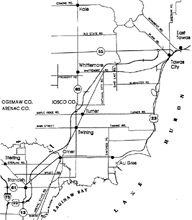
The US-23 corridor in northeast Michigan has been overburdened with local, commercial and tourist traffic, for many years with much of the current highway two lanes wide, with scattered four lane segments. The proposed freeway would have run on a more inland alignment, almost directly from Standish to Oscoda, staying well away from the Lake Huron shore for much of the distance. More than half the proposed freeway was to run adjacent to the established Lake States Railroad (former Detroit & Mackinac Railway) corridor. MDOT had also stated the current shoreline alignment of US-23 would be retained in the state trunkline system and heavily promoted as the "scenic shoreline alternative" to the freeway. It would likely have been signed as either an extension of M-13 or M-61. The Lake Huron Circle Tour routing would also have been retained on the current lakeshore alignment as well.
In early 1999, MDOT submitted a final environmental impact statement to the Federal Highway Administration (FHWA). The statement concentrated on the first phase of the project from Standish to M-55 west of East Tawas. It is reported this first segment would cost $300 million to build. In mid-March 2000, James Steele, FHWA Division Administrator, gave a "thumbs-down" to the EIS submitted by MDOT, "because it gave only two possible choices: building the freeway or not building it," according to an article in the The Detroit Free Press. The article continued, "Steele recommended considering alternatives such as building a less elaborate 'boulevard' or improving U.S. 23 and state highways in the region. Possibilities include adding passing lanes and traffic signals, minor road widening, and improving intersections, he said."
 While MDOT worked during the 1990s to upgrade the US-23, M-65 and M-55 corridors
with the fixes suggested by the FHWA's
Steele, then-MDOT Director
Jim DeSana stood firm in his belief that the region needed more than just
minor fixes to substantially improve the transportation infrastructure.
In the Free
Press article, DeSana stated, "We're going to
make improvements to the current system wherever we can, then ... see what
impact it had on 23. We've got to prove to them [a freeway] is the only
way to handle what we need. Otherwise, they'll just kick it back again."
While MDOT worked during the 1990s to upgrade the US-23, M-65 and M-55 corridors
with the fixes suggested by the FHWA's
Steele, then-MDOT Director
Jim DeSana stood firm in his belief that the region needed more than just
minor fixes to substantially improve the transportation infrastructure.
In the Free
Press article, DeSana stated, "We're going to
make improvements to the current system wherever we can, then ... see what
impact it had on 23. We've got to prove to them [a freeway] is the only
way to handle what we need. Otherwise, they'll just kick it back again."
While many believed the US-23 corridor in Northeast Michigan need more than band-aid fixes to truly solve the region's transportation needs, some championed a "stepped" approach. One suggestion was to gradually phase-in a new highway to the area, starting with a two-lane thoroughfare bypassing Standish, continuing to Omer, then running northeasterly along the railroad corridor past Turner and Twining, meeting M-55 west of Tawas. While only two lanes and lacking overpasses and interchanges, this highway would have been limited-access on ample right-of-way. Then, as time passed and/or traffic demanded, two more lanes could have been added creating a limited access "expressway" or "boulevard," with access limited to select crossroads at various intervals. The next step would have been to build interchanges at the busiest intersections, then construct overpasses at the remaining crossroads, thus arriving at the four-lane, fully controlled-access facility originally proposed by MDOT. In this way, the corridor could have been gradually improved over time, and additional capacity added as needed—or not added if not warranted. The major downside to this suggestion would likely have been higher costs in the end, as building a complete facility all at once is generally cheaper, overall, and less disruptive than continually upgrading it over years.
As much as the opponents claimed the freeway proposal was once-and-for-all dead after the March 2000 FHWA denial, MDOT continued to claim otherwise for a time. Former Director DeSana stated the setback by the FHWA was just that: a setback. The most likely next steps at the time—beyond making spotty improvements to the current highway alignment—were to increase the scope of the study to include alternate choices and alignments, and re-submitting it to the FHWA. But a little more than two years later, in June 2002, MDOT changed course and agreed with FHWA's assessment that the "No-Build" option was the most appropriate for the corridor and officially removed the US-23 freeway from consideration.
Additional Information
- Proposed US-23 Freeway Map
- US-23 Route Listing
- Federal Govt. Rejects New, $1.5 Billion US-23 – archived from the Michigan Land Use Institute
- US-23 Extension – from the Michigan Land Use Institute's "Green Scissors Report".
- Stop Sprawl: The Road to Better Transportation Projects - Michigan US-23: Avoiding Costly Expansion – an archived article from the Sierra Club on how the US-23 Expansion project was halted.